 Morpho blue
 pairs one loan asset with one collateral asset in each isolated lending market
Morpho blue is a variable-rate, overcollateralized lending protocol built from separate markets. Each market pairs one loan asset with one collateral asset and fixes an oracle, interest rate model, and liquidation loan-to-value threshold when created. Suppliers provide the loan asset, while borrowers post the collateral asset and draw from available liquidity. A market's choices stay local to that market.
Before submitting a transaction, check the market's immutable parameters, live utilization, available cash, fees, and current position record. After confirmation, compare the updated onchain record with the intended action before continuing.
Direct markets and curated vaults expose different choices
A direct supplier chooses one market and receives supply shares tied to its loan-asset accounting. Returns and withdrawal liquidity come from that selection. A borrower also enters a specific market, but posts the designated collateral and takes the loan asset. Neither position automatically shares collateral or liquidity with another market, even when the asset pair looks familiar.
A curated vault can provide another supply route. The depositor owns vault shares while configured roles allocate capital to approved markets or adapters within set caps. This route delegates market selection, yet it adds vault governance, allocation, fee, and liquidity conditions. Borrowing remains attached to the underlying market configuration.
A vault route shifts the review toward curator roles, enabled adapters, exposure caps, and exit mechanics. Direct supply leaves the market choice with the depositor and concentrates the claim in that selected pool. Both routes can reach the same underlying market while producing different permissions and, when configured, another fee layer.
Five inputs create the market boundary
Every market starts with a configuration specific enough to separate it from another pool using the same tokens. The relevant inputs are:
- The loan asset is the token suppliers deposit and borrowers receive.
- The collateral asset is the token securing a borrower's debt.
- The oracle quotes collateral value in units of the loan asset.
- The interest rate model, or IRM, defines how the variable borrow rate is calculated.
- The liquidation loan-to-value ratio, or LLTV, sets the debt boundary used for position health.
The market ID is derived from the loan token, collateral token, oracle, IRM, and LLTV. A different oracle or LLTV therefore produces a separate market with its own positions and liquidity. Once created, those five inputs can't be edited. Anyone may submit a valid configuration, although the deployment's enabled IRMs and LLTVs limit which configurations can be created.
The creator chooses the initial combination, not future account balances or the rate returned by the IRM. The same configuration on another chain or contract deployment doesn't combine liquidity with this market. Chain and contract context remain part of identifying the actual pool.
Supply shares track a claim on one market
Supplying the loan asset mints supply shares rather than fixing a static token balance. Those shares represent a proportional claim on the market's total supply assets. Borrower interest generally raises their asset value after any market fee, while realized bad debt can reduce it. A fresh conversion from shares to assets is needed to understand the current claim.
Collateral uses separate accounting. It secures the user's borrowing position and doesn't earn the market's supply yield. A wallet may hold supply shares, borrow shares, and collateral in the same market, but the supply position isn't automatically counted as collateral. That distinction matters when calculating return, withdrawal access, and liquidation exposure.
Supplying collateral alone doesn't create borrowing debt. The health constraint begins to matter once debt is drawn, or when collateral is removed from a position with debt already outstanding. Loan-asset supply and collateral supply therefore produce different records even when one wallet performs both actions.
Collateral value sets the borrowing boundary
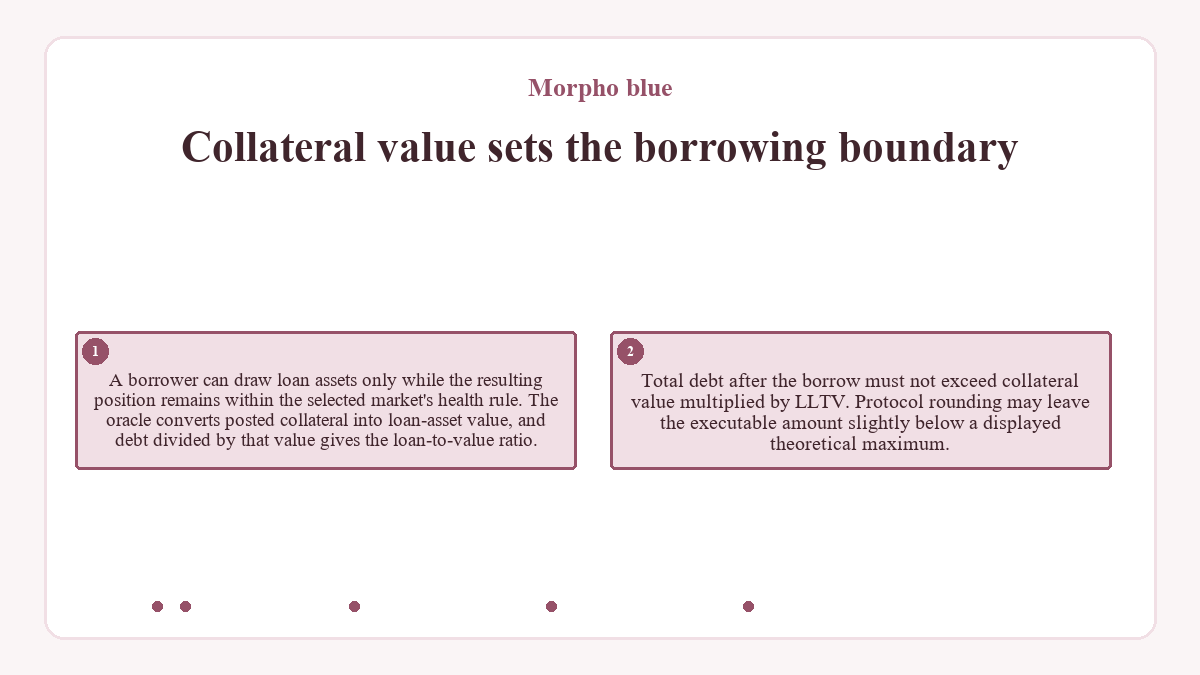
A borrower can draw loan assets only while the resulting position remains within the selected market's health rule. The oracle converts posted collateral into loan-asset value, and debt divided by that value gives the loan-to-value ratio. Total debt after the borrow must not exceed collateral value multiplied by LLTV. Protocol rounding may leave the executable amount slightly below a displayed theoretical maximum.
LLTV is a liquidation boundary, not a suggested operating target. Interest increases debt over time, so LTV can rise even when the oracle price doesn't move. A lower collateral quote can raise it more abruptly. Repayment or additional collateral can restore distance from the boundary, while any collateral withdrawal must leave the remaining position healthy.
Collateral isn't cross-margined between markets at the core level. Surplus collateral beside one loan can't rescue a separate position automatically, even if both markets use the same token contracts. Each debt must satisfy the health rule of its own market.
What makes the interest rate move?
The market's IRM makes the borrow rate respond to utilization, which is total borrowed assets divided by total supplied assets. Its contract address is fixed for that market, but the rate it returns is dynamic. The AdaptiveCurveIRM shifts its curve upward when utilization stays above its target and downward when it stays below.
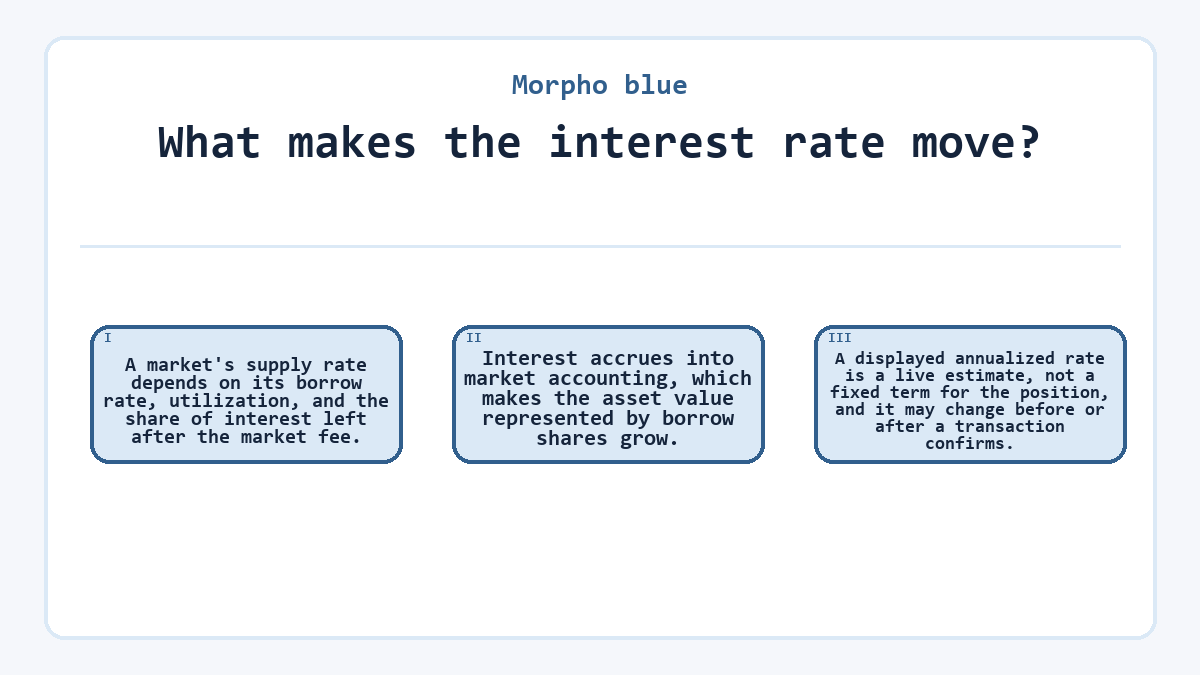
A market's supply rate depends on its borrow rate, utilization, and the share of interest left after the market fee. Interest accrues into market accounting, which makes the asset value represented by borrow shares grow. A displayed annualized rate is a live estimate, not a fixed term for the position, and it may change before or after a transaction confirms.
How can a borrower confirm a position opened?
A borrower can confirm completion by pairing a successful transaction receipt with a fresh onchain position record for the same market ID.
Every quantity in this hypothetical case is invented for illustration. Assume 137 collateral units, an oracle quote of 2 loan-token units per collateral unit, a request to borrow 170 loan-token units, and a market LLTV of 77%. The collateral is worth 274 loan-token units, the LLTV boundary is 210.98, and the requested debt produces an LTV of about 62.04%.
The request fits the stated LLTV boundary. If the market has enough available loan assets, the borrower can supply the collateral and request 170 loan-token units. Cost still depends on the live borrow rate and network execution fee. Any market fee changes how borrower interest is divided between suppliers and the fee recipient; it doesn't turn the rate into a fixed quote.
On the normal path, the receipt reports success and the updated record shows 137 collateral units plus borrow shares representing roughly 170 loan-token units before later interest. If the receipt succeeds while an indexed display lags, a direct state read at or after the confirmed block resolves that edge case. A reverted receipt or unchanged contract position means the borrow wasn't completed, so continuing as though funds arrived would use the wrong starting state.
Liquidation follows the chosen LLTV
A position becomes liquidatable when its debt exceeds collateral value multiplied by the market's LLTV. An external liquidator can repay part or all of the debt and receive collateral with the protocol's liquidation incentive. Debt growth, a lower oracle price, or both can cross the boundary.
If the available collateral can't cover the obligation during liquidation, the remainder can become bad debt. Realized bad debt reduces the value available to suppliers in that market. Market isolation keeps the accounting loss local, but a vault allocated to the affected market passes its share of that loss through its own share accounting.
Available liquidity controls lender exits and new borrows
Solvency and liquidity answer different questions. A market may have well-backed loans yet lack enough unborrowed loan assets for an immediate supplier withdrawal or another borrow. The supplier's shares remain recorded when a withdrawal can't be filled. Higher utilization may raise rates through the IRM, but it doesn't guarantee cash will return on a particular schedule.
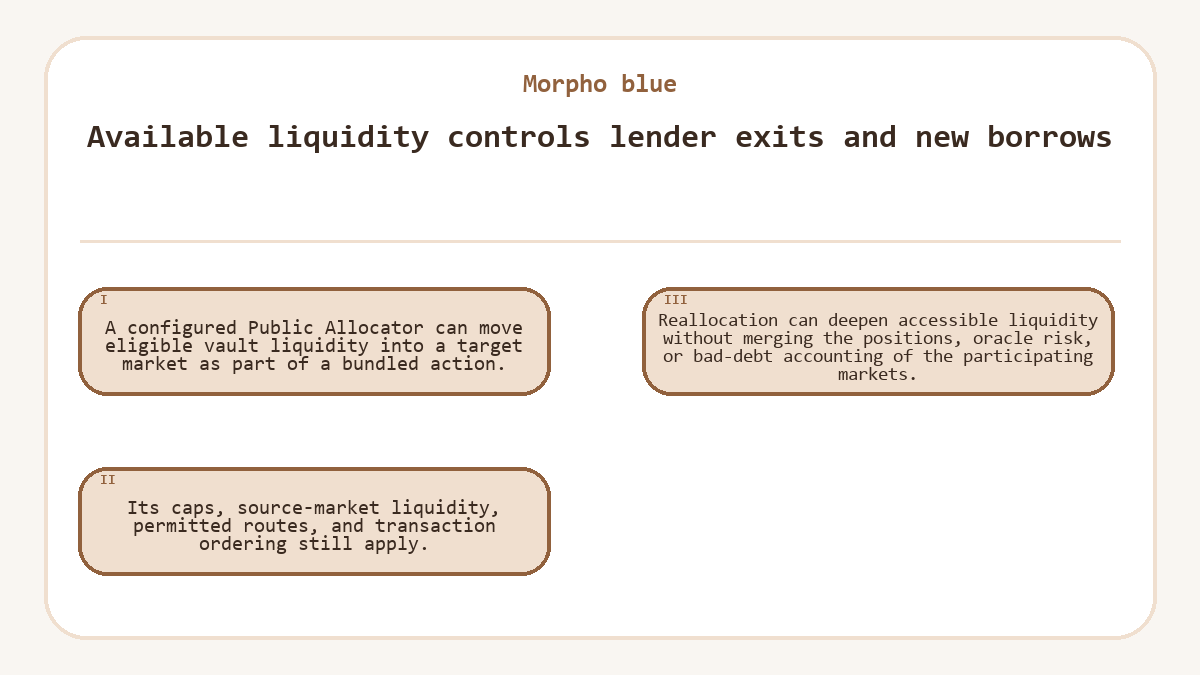
A configured Public Allocator can move eligible vault liquidity into a target market as part of a bundled action. Its caps, source-market liquidity, permitted routes, and transaction ordering still apply. Reallocation can deepen accessible liquidity without merging the positions, oracle risk, or bad-debt accounting of the participating markets.
Costs come from interest, fees, and execution
Borrower cost includes the variable interest accrued under the IRM, while the submitted transaction also incurs a network execution fee. A market fee, when set, retains part of borrower interest before the remainder reaches suppliers. That fee is separate from the five immutable inputs and may change under the protocol's fee authority. A vault or optional routing contract can introduce another fee layer under its own configuration.
Quoted yield also needs a clean split between native interest and temporary incentives. Reward APR doesn't alter the market's debt, LTV, or supply-share conversion. It may change the displayed net return while a campaign runs, then disappear under the campaign's own terms. Comparing positions on native APY, rewards, and execution cost as separate inputs avoids treating a changing incentive as a protocol constant.
A token approval authorizes a contract to transfer a stated asset amount; it isn't itself an interest charge. Approval transactions can still consume network gas, and broad allowances create a separate permission to review. The total execution cost depends on the path actually submitted, including any bundled or vault action.
Isolation narrows contagion but leaves shared dependencies
Each market owns its liquidity, positions, interest accounting, and realized bad debt. A loss in one isn't automatically charged to suppliers in every other market.
The same token or oracle can appear in several markets. Faulty pricing, oracle downtime, token blacklisting, or an asset contract failure can therefore affect every position relying on that shared component.
Immutable core parameters prevent a market creator from swapping the oracle, IRM, LLTV, or asset pair after creation. Immutability doesn't remove smart-contract, blockchain, or dependency risk.
Vaults can aggregate exposure by allocating to several markets and adapters. Their caps and roles govern that layer, while each underlying market keeps its own ledger. Isolation limits where a loss is booked; shared inputs determine how many positions encounter the same failure.
Repayment and reconciliation close the position
A borrower releases collateral by repaying enough debt to keep the position healthy, or by clearing the debt before taking all collateral. Because interest and share conversion can change the asset amount, a full repayment is more reliable when it burns the fresh borrow-share balance. Repaying a stale asset estimate can leave a small debt balance, while a partial repayment deliberately leaves some borrow shares open.
A supplier exits separately by redeeming supply shares for available loan assets. After a borrower's closing transaction, the market record should show zero borrow shares before the full collateral balance is withdrawn. If borrow shares remain, the position hasn't been fully reconciled, and the health check still constrains collateral withdrawal.
Frequently asked questions
Does using Morpho blue require holding MORPHO?
No. Core lending and borrowing don't require MORPHO as an input or collateral unless a particular market separately uses that token as one of its assets. The wallet still needs the network's native gas asset and any required token approval. Reward campaigns may distribute MORPHO, but an incentive isn't a prerequisite for the core market transaction.
Can a market exist before anyone supplies liquidity?
Yes. Creating a valid market records its immutable parameters, but it doesn't seed loan assets. Until suppliers deposit the loan asset, borrowers have no liquidity to draw. An empty market can still exist onchain, and later deposits can create usable liquidity without changing the market's oracle, IRM, collateral asset, loan asset, or LLTV.
Which token contracts can define a Morpho blue market?
Both the loan and collateral tokens must support the ERC-20 transfer behavior the core expects. An ERC-4626 vault token shouldn't be used as the loan asset. Technical compatibility doesn't establish sound collateral. Transfer restrictions, upgrade controls, blacklisting, and price behavior can still create market-specific risk.
Can another address repay a borrower's debt?
Yes. The core repay function can accept loan assets from a caller and reduce another address's debt through its on-behalf parameter. That doesn't give the payer control over the borrower's collateral or permission to borrow from the position. Borrowing and withdrawals on another account require the account's authorization, which applies across that protocol deployment's markets.
Why can two interfaces show different APYs for the same market?
Interfaces can use different blocks, compounding conventions, averaging windows, and reward treatments. One may show native supply APY after the market fee, while another adds a temporary reward APR or uses older indexed data. The underlying market rate is still driven by its IRM and utilization, so compare like-for-like components and timestamps.
Do reward tokens reduce the debt recorded by Morpho blue?
No. Reward tokens are separate incentives and don't reduce the borrow shares or debt assets recorded by Morpho blue. Even when an interface presents a net borrowing rate after rewards, interest continues to accrue under the market's IRM, and the position's LTV uses the actual debt. A campaign can also end or change independently of the loan.
When does a Morpho blue variable-rate market expire?
A Morpho blue variable-rate market has no loan maturity date built into its five market parameters. Once created, its configuration persists with the deployed contract and underlying chain. Individual users can enter or leave when their position and market liquidity allow, but an empty or inactive market doesn't automatically expire or reset its parameters.
· updated