 Morpho blue
 market comparisons start by verifying fixed inputs before reading live rates
Morpho blue markets can share an asset pair while differing in the oracle, interest rate model (IRM), and liquidation loan-to-value threshold (LLTV) fixed at creation. Compare those permanent inputs first, then read utilization, available liquidity, fees, and rates from the same observation point. A quoted annual percentage yield (APY) is meaningful only inside that complete record.
Start by deciding what an acceptable market must preserve: a particular loan and collateral relationship, a liquidation boundary, enough withdrawable liquidity, or a rate range. That condition determines which inputs can disqualify a market before any live quote enters the comparison.
Key takeaway: Separate permanent market parameters from live conditions, then compare every candidate against the same liquidity, rate, and risk requirements.
Matching asset roles makes market comparisons fair
A supply comparison starts with markets using the same loan asset. A borrowing comparison also needs equivalent collateral roles and the same intended loan asset. Otherwise, a rate difference may come from comparing different exposures rather than different configurations. Token symbols aren't sufficient evidence because contracts, decimal conventions, and asset roles can differ.
Permissionless creation allows more than one market to use a familiar pair, but the IRM and LLTV must be approved by governance before a market can use them. Each market binds that pair to a specific oracle, IRM, and LLTV. No single input declares a winner. Check whether every candidate performs the same function under the stated condition, such as preserving a chosen collateral relationship while maintaining enough available loan assets.
Market identity comes before quoted performance
Capture the market identity before collecting rates because a live metric can't repair a mismatch in the underlying market.
Chain and contract deployment
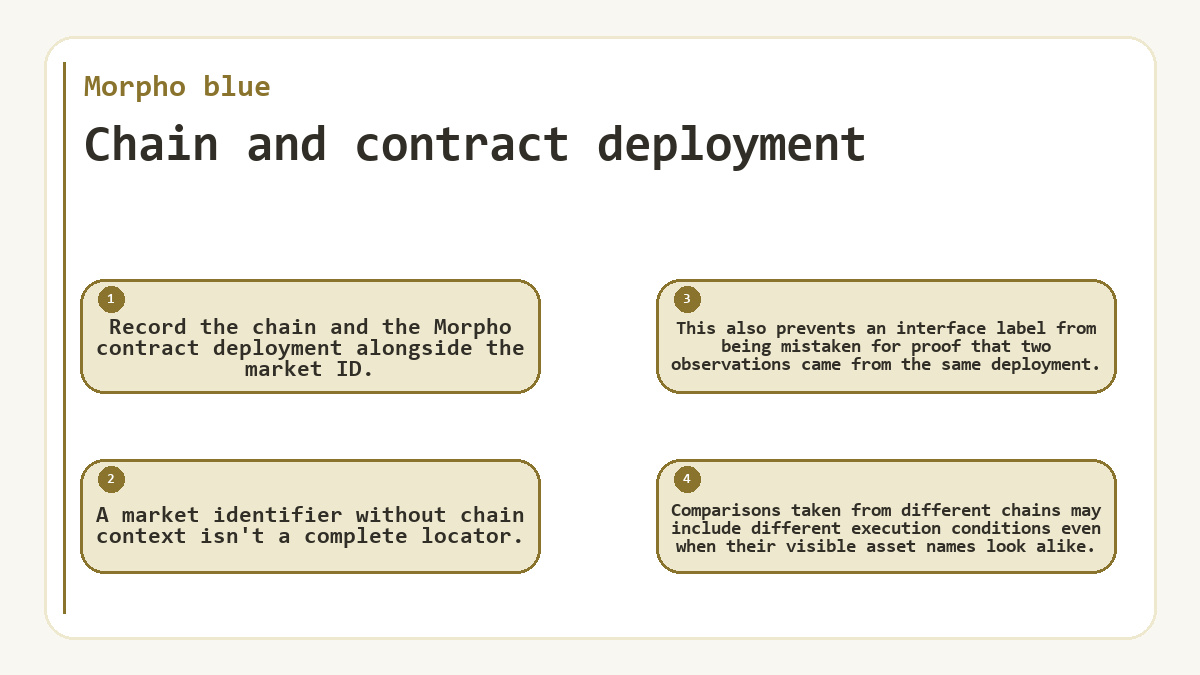
Record the chain and the Morpho contract deployment alongside the market ID. A market identifier without chain context isn't a complete locator. This also prevents an interface label from being mistaken for proof that two observations came from the same deployment. Comparisons taken from different chains may include different execution conditions even when their visible asset names look alike.
Asset addresses and roles
Match loan and collateral contract addresses, then keep their roles unchanged across candidates. The loan asset is supplied and borrowed, while the collateral asset secures debt in that market. Reversing those roles creates a different economic question. Decimal precision also matters when raw balances or oracle outputs are interpreted, so normalized display amounts should trace back to the relevant token contracts.
Oracle, IRM, and LLTV
A market's loan asset, collateral asset, oracle, IRM, and LLTV form the parameter set used to derive its market ID. Those parameters remain attached to the market after creation. If any one differs, treat the candidate as a distinct market and evaluate the consequence directly. A new configuration requires another market rather than an edit to the existing parameter set.
How should live rates be compared?
Compare live rates from the same block or closely aligned observation time, with utilization and the market fee beside them. Borrow APY is derived from the IRM's rate, while supply APY reflects the portion of borrower interest suppliers earn after accounting for utilization and any market fee. In simplified form, supply APY follows borrow APY multiplied by utilization and by one minus the fee.
The displayed APY is a snapshot, not a fixed term. Transactions can change utilization, and an adaptive model may move its curve as conditions persist. Keep incentive rewards separate from the base market rate because their token, schedule, and eligibility can change independently. Transaction costs also sit outside the market APY and may affect whether acting on a small difference is worthwhile.
Liquidity gives the rate its operating context
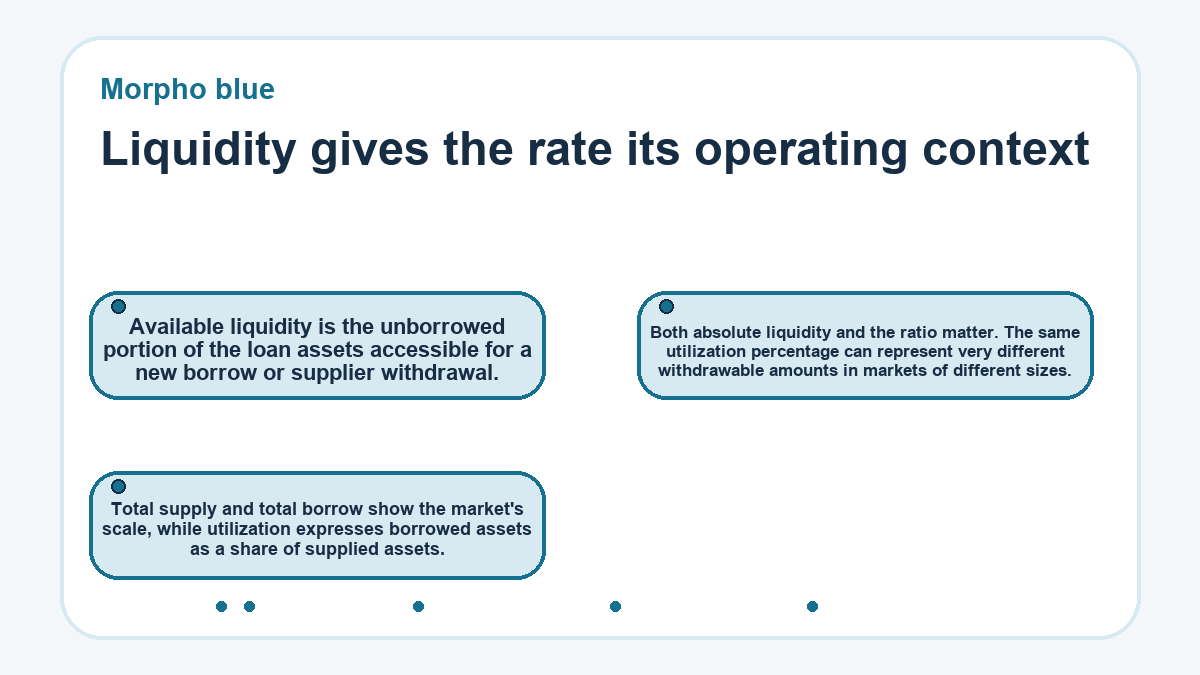
Available liquidity is the unborrowed portion of the loan assets accessible for a new borrow or supplier withdrawal. Total supply and total borrow show the market's scale, while utilization expresses borrowed assets as a share of supplied assets. Both absolute liquidity and the ratio matter. The same utilization percentage can represent very different withdrawable amounts in markets of different sizes.
High utilization can coincide with a higher borrow rate and a competitive supply quote, yet leave little room for an immediate exit or a new loan. Low utilization may leave a larger share unused but still provide little absolute capacity when total supply is small. Compare the amount available with the intended action, not with an unqualified label such as high or low liquidity.
Oracle design changes the meaning of collateral value
The oracle determines how collateral is valued in units of the loan asset. Two markets with identical token roles and LLTV can therefore produce different risk profiles when their oracle implementations use different pricing paths, update behavior, or dependencies.
Price path and denomination
Confirm the oracle prices the selected collateral against the selected loan asset and handles both assets' decimal scales correctly. For wrapped or yield-bearing collateral, the path may need an exchange-rate component as well as an external price feed. The displayed collateral value is only comparable after the complete conversion path is understood; a matching dollar display doesn't prove the underlying paths are equivalent.
Freshness and failure behavior
Review how the oracle responds to stale inputs, interrupted feeds, extreme deviations, or a failed upstream dependency. An address alone identifies the contract but doesn't describe these behaviors. Since the oracle is fixed in the market parameters, a weakness can't be removed from that market by replacing the oracle later. That permanence makes oracle design a disqualifying input when it conflicts with the reader's requirements.
LLTV sets a boundary rather than a target
LLTV defines the debt level at which a position becomes eligible for liquidation relative to the oracle-valued collateral. A higher LLTV permits more borrowing against the same reported collateral value. The liquidation buffer depends on the position's starting loan-to-value, not on LLTV alone. It doesn't measure oracle quality, available liquidity, or the likelihood liquidators can close an unhealthy position without bad debt.
Compare LLTV with the intended starting loan-to-value and the adverse movement the position must withstand. Interest accrual increases debt over time, while a lower oracle valuation reduces the collateral side of the ratio. Markets sharing an LLTV still aren't equivalent if their oracle paths or borrowing costs differ. Measure the remaining buffer under each market's own inputs.
IRM choice and market state belong in the same view
The IRM supplies the rate logic, while market-specific state determines where that logic operates. Reading only the current APY hides how the quote may react when utilization changes.
The curve at the observation point
Record the IRM address, current utilization, current borrow rate, and any curve data exposed for that market. When candidates use different approved models, compare their rates at the same utilization levels rather than comparing one current point from each. When they share an IRM, identical logic still doesn't guarantee an identical rate because market-specific state and utilization can differ.
State after conditions move
An adaptive IRM can raise or lower its rate curve as utilization remains above or below its target. A rate captured during a brief liquidity change may therefore say little about the cost after conditions persist. The comparison should show how much borrowed or supplied liquidity would move utilization and what the model would then report. It can't establish a fixed future APY because later supply, borrowing, repayment, and withdrawal remain unknown.
A decision-ready market checklist
The comparison is ready when every candidate has the same functional basis and enough recorded state to reproduce the decision. Use one checklist for all candidates:
- Define the required loan and collateral roles, plus the condition each market must satisfy.
- Record the chain, deployment, market ID, token addresses, oracle, IRM, and LLTV, then mark which fixed inputs differ.
- Capture total supply, total borrow, utilization, available liquidity, fee, and base rates at one observation point.
- Evaluate the oracle path, LLTV buffer, and IRM response under the same assumptions.
- Separate market APY from incentives, vault-level figures, and transaction costs before ranking candidates.
Save the block or timestamp with the snapshot. Without that reference, later rate and liquidity changes can make two accurate readings appear inconsistent. A candidate failing a required condition should remain excluded even if its current APY is higher.
Which market fits the condition you set?
The fitting market is the one whose fixed parameters pass the nonnegotiable constraints and whose live state meets the recorded threshold. Rank only the candidates left after those checks, applying the same rate, liquidity, oracle, and borrowing-buffer measures to each. An attractive metric shouldn't override a failed requirement.

Refresh the live snapshot before acting because liquidity, utilization, oracle output, and rates can move. If no candidate still satisfies the condition, waiting is a valid outcome. Changing the requirement is also possible, but it should be an explicit new comparison rather than a hidden relaxation of the original decision.
What readers ask about Morpho blue
-
Should incentive APR be added to a market's base supply APY?
- No. Keep incentive APR separate from the base supply APY because rewards can use another token, follow a separate schedule, and apply only to eligible positions. Base supply APY comes from the market's borrow rate, utilization, and fee. Combining the two can make a temporary reward look like part of the lending market's durable interest mechanism.
-
Can low utilization hide a small amount of available liquidity?
- Yes. Utilization is a ratio of borrowed assets to supplied assets, so a lightly used but very small market may still hold little absolute liquidity for a planned borrow or withdrawal; compare the unborrowed amount with the intended action as well as reading the utilization percentage.
-
Which records make a saved market comparison reproducible?
- A reproducible record includes the chain, contract deployment, market ID, five market parameters, and the block or timestamp used for live readings. Save total supply, total borrow, utilization, available liquidity, fee, oracle output, and base borrow and supply rates from that point. Without the observation reference, later state changes can make the original ranking impossible to reconstruct.
-
Can a Morpho blue market APY be compared directly with a vault APY?
- Not without separating the two layers. A direct market APY reflects one market's rate, utilization, and fee, while a vault may allocate its assets across several markets and apply vault-level rules or fees. Incentives may also be reported differently. Compare direct markets with direct markets unless the decision specifically concerns the vault's complete allocation and fee structure.
-
Why might a market appear in one interface but not another?
- Interfaces can apply their own listing rules, warnings, filters, and regional availability controls. Removing a market from an interface doesn't delete the underlying market or change its immutable parameters. For comparison purposes, record the onchain market identity separately from its listed status, then treat any interface warning as additional context rather than proof of a different market.
-
Does a high borrow APY mean liquidation is near?
- No. Liquidation eligibility depends on the position's debt relative to its oracle-valued collateral and the market's LLTV. A high borrow APY can increase debt faster and gradually reduce the available buffer, but the rate alone doesn't reveal the current loan-to-value ratio. Position health and the market rate answer different questions and should be recorded separately.
-
When should a saved Morpho blue comparison be refreshed?
- Refresh it immediately before using the result for a transaction or position change. Fixed parameters need rechecking only to confirm the same market was selected, but rates, utilization, liquidity, fees, and oracle output are live readings. A refresh is also necessary after a material supply, borrow, repayment, or withdrawal changes the candidate market's state.
· updated